Red Pill
In one sentence
A Red Pill is the moment a platform’s administrative UI rejects an action that the platform’s documentation explicitly enables, at a validation layer the documentation does not mention.
The morning the name arrived
This reminded the operator of the movie The Matrix, of course, but it is actually unrelated to that pill. In The Matrix, Neo is offered a choice by Morpheus. The red pill allows you to see reality as it is. The blue pill allows you to keep living in your gooey pod, watching AI videos of women in red dresses, apparently.1 We won’t go into how this image has been stolen and co-opted by various groups; even The Matrix took it from Total Recall (1990), where Arnold Schwarzenegger is asked to swallow a red pill as “a symbol of your desire to return to reality” — though the film presents the offer as a deception and leaves it ambiguous whether the pill does anything at all. The Matrix borrowed the symbol and cleaned up the ambiguity - the red pill definitely packs a punch. But also, and I know this because I have a blister pack in the door of my 2004 Chevy 2500HD, Vicks DayQuil Cold & Flu LiquiCaps are red and the NyQuil are greenish blue. So if you want to have some fun with people and offer coloured pills, this could be the ticket.
Which brings us, by a route only a Dictionary entry would take, to Google Analytics.
OpenClaw fixing
This is the part of OpenClaw work that makes some people sad about OpenClaw. You wire up an agent to monitor your Substack readership and quietly deliver the numbers each morning. The numbers themselves are usually a little sad — nobody reads your Substack posts unless you blast the world — but at least they arrive, and you can drink your coffee and accept the verdict. Then one morning the report does not arrive. You open the cron logs instead, and you find yourself trying to fix a pipeline that exists to deliver bad news. And you wonder why you even bother.
This is OpenClaw fixing. It is what the work actually looks like from inside. There is a temptation, in this moment, to give up and reach for the browser tab — to let Anthropic’s Claude Desktop, or one of the other vendor-hosted surfaces, handle the agent business in their sandbox, where the OAuth tokens are someone else’s problem. That is a real option, and on a bad morning it is tempting. But it is also a different bargain. The Path is The Goal. If you actually want to understand how agents work — how they authenticate to other people’s platforms, how they fail when the platforms refuse them, how the administrative surfaces of the modern internet differ from their documentation — you cannot have it both ways. You can be beholden to a browser-based system run by someone else, or you can build your own. The morning OAuth failure is the curriculum for the second path. It is also an unwanted email.
The worked example, May 11, 2026
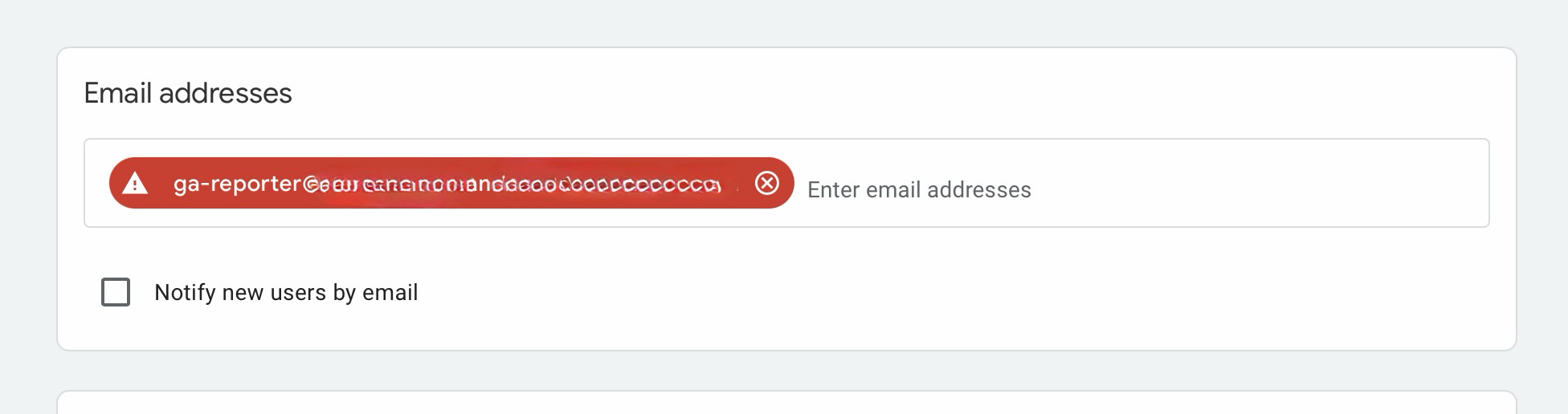
The Dictionary’s GA cron ran cleanly for five days, then started failing at 5:30 AM on May 9, 10, and 11. The refresh token had expired and I have been notified three days running. The fix looked routine: migrate from user-OAuth to a service account, which is Google’s documented mechanism for exactly this kind of unattended-process authentication. The service-account key was in the workspace, the project was verified, the GA Admin role was attached to my own account. The next step, per the documentation, was to add the service-account email as a user on the GA4 property. That is where the UI said no. The field rejected the address with a red pill of an icon, a warning triangle, and an X. The dialog offered no path forward. The naming arrived at 06:09 EDT: Add Red Pill to our dictionary queue.
The agent then asked me to review the hero image, to make sure the service-account email was properly obfuscated before the screenshot went into the entry. Hero image. English majors will love the brave new world of agentic AI. The operator drafts a Dictionary entry about a refusing form; the agent volunteers a screenshot of the refusal; the agent then asks the operator to verify the agent’s own redactions of the embarrassing details inside that screenshot, so that the screenshot can serve as the hero image of a Dictionary entry about administrative friction. Rich in irony. Abandon hope, all ye who enter here? Perhaps. But also — my gentle Puck, come hither. The work is at once infernal and comic, and on a good morning one notices both.
What the term names
The action is permitted on paper. The rules-as-written allow it. The form refuses anyway, with a red pill of a UI element and no path forward from the dialog. The administrative dictionary recognises the syntax of the request but refuses the meaning.
Adjacent vocabulary exists but does not quite cover the case. Administrative friction is too general — it names every form that took longer than it should have. Configuration impedance is engineer-speak for a related problem in a different layer. Vendor lock-in by indirection is closer but still does not name the specific phenomenon. None of these capture the active refusal at a layer beneath the docs. Red Pill does.
Why the name is right
The red colour does the work. Red pill in the Matrix-reference sense is the disillusioning truth one accepts knowingly. Red pill in the UI sense is a small visual element a platform uses to indicate refusal. The double meaning is operationally accurate: the operator who sees the red pill is learning the truth about the platform — the truth being that the documentation does not match the administrative surface. The colour also marks the boundary between I expected this to work and I now know it does not. Naming the visual element gives operators a shared word for the experience.
The structural shape, generalised
The Red Pill is platform-neutral. The same phenomenon appears across the major platforms in different forms. AWS IAM has its variants — cross-account principal restrictions, SCP refusals not surfaced in the IAM UI. Azure has tenant-restricted service-principal additions. GitHub Enterprise has SAML-enforced membership barriers. GA4 is the worked example here because it is the one that bit us today, but the structural property generalises: administrative UIs that validate against identity systems whose documentation is written separately will refuse documented capabilities at the field layer, and the refusal will not be surfaced in the docs.
The shape:
- Platform offers capability.
- Documentation describes capability.
- Administrative UI refuses capability at a validation layer not named in the docs.
- Alternate path exists but is not surfaced from the dialog.
- Operator burns hours discovering the alternate path.
The hours burned are real architectural cost. They should be counted in any sovereignty calculator. The Red Pill is administrative friction made visible by the colour red. The visibility is itself a kindness — worse failures fail silently.
Why it matters for operators
The Red Pill is one of the most under-named operational hazards in sovereignty work. Operators plan their architecture against published documentation, only to discover late — often during an actual outage — that the platform’s administrative layer will not honour what its technical layer permits. Plans built on rules-as-written underestimate the cost of completing the work; the real-world cost includes the unwritten administrative tax of finding the alternate path. Naming the phenomenon lets us budget for it in advance and lets us recognise it quickly when it appears, rather than thrashing against a form that will never accept what we are putting in.
What an operator does when they encounter one
Stop pasting the same input into the same form. Look for the API alternative. Look for an Admin Console path the user UI does not expose. Look for the programmatic equivalent of the action. The administrative UI is one path of many; the documentation often names the others if you read it with a different question in mind — not how do I do this? but what other surface lets me do this?
For the May 11 example, Google documents a programmatic route through the GA Admin API’s v1alpha/properties/{property}/accessBindings resource. That proves an alternative administrative surface exists. It does not prove, by itself, that the API bypasses the identity validation encountered in the user interface. That remained the operator’s working theory, not a documented property of the endpoint.
The Path is The Goal.
— Prof. Langenkamp May 11, 2026
See also: Mediation (a la Gibson) · Capability Overhang · Commercial Legibility · FERPA Compliance Posture
Source
- Google Analytics Admin API, Method: properties.accessBindings.create.
-
One correction from the operator, in fairness to the film. The woman in the red dress is not Neo’s vision in his pod; she appears in the training simulation that Neo walks through with Morpheus, programmed by Mouse. Cypher (played by Joe Pantoliano) is the Judas figure of The Matrix: the crew member who betrays Morpheus to Agent Smith in exchange for being reinserted into the simulation as someone rich and important. His most famous line is delivered over a steak the audience knows is not real: “Ignorance is bliss.” The separate internet story that the Wachowskis’ original screenplay used human brains as computer processors rather than batteries is not supported by the accessible 1997 screenplay, which already contains the battery explanation. The processing-capacity metaphor remains interesting; its supposed screenplay provenance does not. ↩